An employee receives a customer email, copies it into an AI assistant and asks for a summary. Another uploads a contract to generate a reply. A third uses a meeting transcription tool without checking where the recording is stored.
Each action may feel like a small productivity shortcut. Together, they can create an unmanaged flow of customer information into services the business has never assessed.
The answer is not that SMEs must avoid AI whenever personal data is involved. Nor is it that a paid subscription automatically makes every use safe. The practical answer depends on the purpose, the sensitivity of the information, the tool’s terms and controls, the people who can access it, and what happens to the output.
This article provides an operational decision framework for Singapore SMEs. It is general information, not legal advice. Organisations should obtain appropriate legal or data-protection advice for their circumstances, particularly where sensitive data, regulated activities or consequential decisions are involved.
Begin with the purpose
Before examining product features, state why customer data is needed.
“We want to use AI” is not a purpose. “We want to summarise support enquiries so an employee can identify missing information faster” is a purpose. It identifies the input, intended output and human user.
Then ask whether the same result can be achieved with less data. A model may not need the customer’s full name, identification number, address and account history to classify an enquiry by topic. Removing unnecessary fields lowers exposure and often improves the prompt by focusing it on relevant information.
This is the first control: do not provide data merely because it is available. Use the minimum information needed for the defined task.
Customer data is not one risk category
Treating all customer information as equally sensitive leads to poor decisions. Teams either ban useful low-risk applications or handle serious information too casually.
Create a simple classification that employees can understand.
Public or non-personal information
Examples include published product descriptions, public opening hours, generic procedures and anonymised scenarios that cannot reasonably identify a person. These are generally the easiest materials to use in an approved AI tool, subject to copyright, confidentiality and accuracy considerations.
Ordinary business contact information
Names, work email addresses, job titles and routine correspondence may still be personal data. They should be used only for an approved purpose and in an approved service. The fact that information appears on a business card does not make every onward use appropriate.
Confidential customer information
Contracts, pricing, complaints, purchase histories, internal notes and unpublished business plans can create commercial harm even when they contain limited personal data. Confidentiality commitments may impose restrictions beyond general privacy obligations.
Sensitive or high-impact information
Identity documents, financial details, health information, precise location, credentials and data used for decisions affecting rights or access deserve stricter treatment. Employees should not place these materials into a general AI tool without a documented assessment and explicit organisational approval.
The classification must reflect business context. A delivery address may be routine for fulfilment but highly sensitive in another situation.
Understand what “putting data into AI” means
Data does not enter only through a visible chat box. An AI-enabled product may receive information through:
- uploaded files;
- connected email or cloud storage;
- meeting recordings and transcripts;
- browser extensions;
- customer-service integrations;
- automated programming interfaces;
- prompts and feedback fields; and
- logs created by the tool or connected workflow.
The organisation needs to understand the full route. A workflow may send the original document, extracted text and generated output to different services. Each transfer may involve separate retention, access and security arrangements.
Draw a simple data-flow diagram. Mark where the information originates, which systems receive it, what is stored, who can access it and when it is deleted. If the team cannot explain the path, it is not ready to approve sensitive use.
Consumer accounts and managed business services are different
Employees often begin with a free personal account because it is quick. That convenience can bypass organisational controls.
A managed business service may provide administrative access, single sign-on, user removal, audit logs, contractual data terms, retention options and commitments concerning model training. The exact features vary by provider and plan. Marketing labels such as “business” or “enterprise” should be verified against current documentation and contract terms.
Ask whether prompts and uploads are used to improve provider models. Determine whether that behaviour can be disabled and whether the setting applies to all users. Check retention periods, deletion methods, data locations, subprocessors and support access. Confirm how the provider handles a security incident and how the organisation can retrieve records needed for an investigation.
These questions do not guarantee safety, but they make the decision evidence-based.
PDPA responsibilities do not disappear
Using an external AI service does not transfer the organisation’s accountability for personal data. Singapore’s Personal Data Protection Act establishes obligations covering areas such as appropriate purposes, notification, consent where applicable, protection, retention limitation, access and correction, transfer limitation and breach notification.
The precise application depends on the circumstances. Operationally, an SME should be able to explain:
- why it is using the data;
- whether the use is consistent with what the customer was told;
- whether the amount of data is proportionate;
- which vendor processes the information;
- how access is protected;
- how long the information is kept;
- how it can be deleted or corrected; and
- how the organisation would identify and respond to a breach.
PDPC guidance on personal data in AI recommendation and decision systems emphasises accountability and transparency across AI deployment. Even when a tool merely drafts or summarises, its use should fit the organisation’s data-protection policies and risk assessment.
Consult a Data Protection Officer or qualified adviser when the answer is unclear.
The output can also expose customer data
Risk does not end after the model processes the prompt. Generated content may repeat sensitive details, combine information from several records or appear in an inappropriate destination.
For example, an employee may ask for a customer-case summary and then paste the result into a shared project channel. A generated email may include internal notes that were never intended for the recipient. A knowledge assistant with weak permissions may reveal a document to an employee who could not access the original file.
Apply access controls to the output as well as the input. Preserve source permissions where possible. Avoid building a single knowledge base that makes every document visible to every user. Require human review before external communication, and make sensitive fields visible enough for reviewers to notice them.
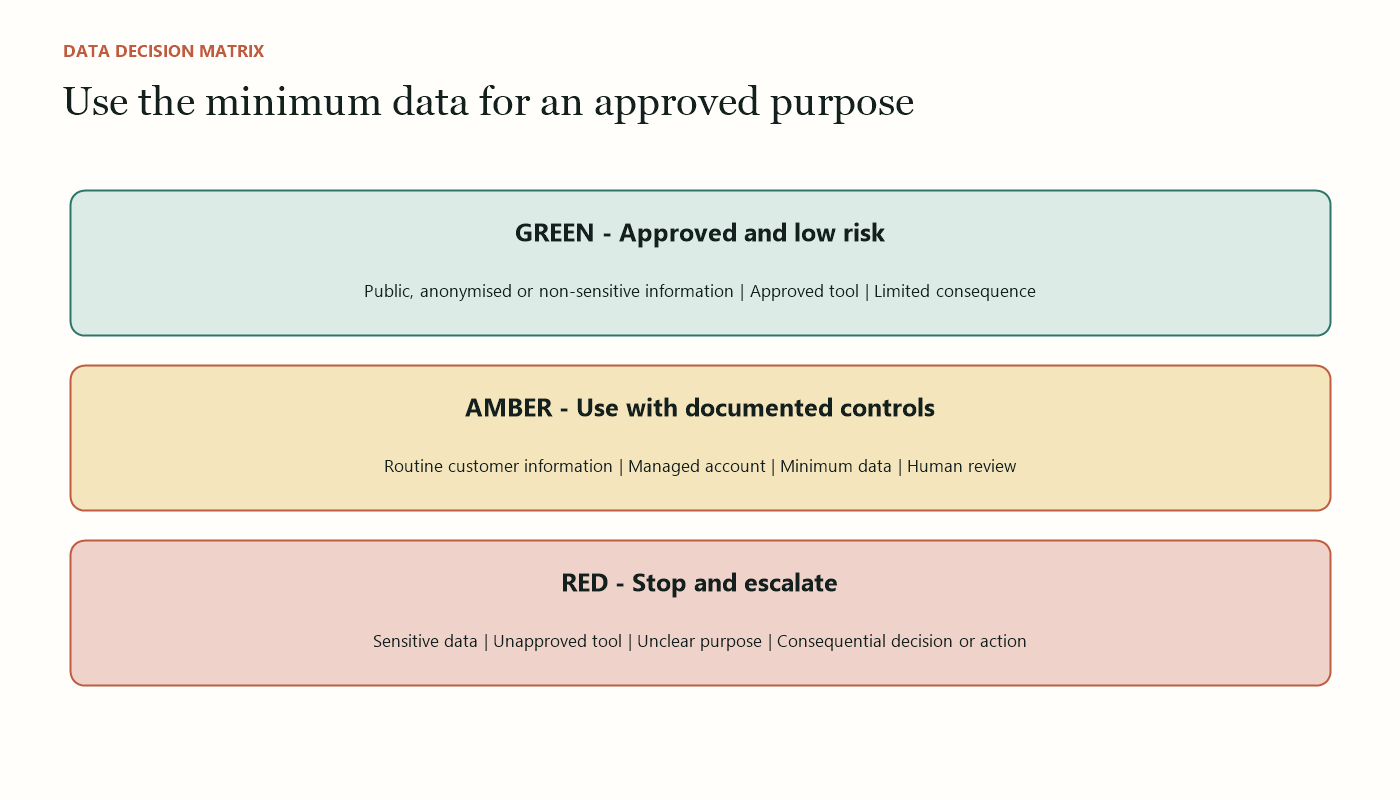
Use a traffic-light decision model
A simple classification helps employees act consistently.
Green: approved and low risk
The information is public, properly anonymised or non-sensitive; the purpose is defined; the tool is approved; and the output has limited consequence. Examples include rewriting a public product description or summarising an anonymised internal scenario.
Green does not mean no review. Generated facts and claims still require verification.
Amber: permitted with controls
The task uses routine customer information or confidential business context in a managed service. Access is limited, the organisation understands the vendor terms, and a person reviews the output before action.
Examples may include summarising a support enquiry inside an approved account or drafting a reply from a customer’s message. Record the purpose and controls, and remove unnecessary identifiers.
Red: stop and escalate
The information is highly sensitive, the tool is unapproved, the purpose is unclear, or the AI output will influence a consequential decision. The workflow may also be red when the provider’s data practices cannot be established.
Examples include uploading identification documents to a personal AI account, allowing an agent to access payment credentials or using an AI score to make an employment or credit decision without appropriate governance.
The red route should name the person who can assess the case. “Do not do this” is incomplete if employees have no way to obtain a timely answer.
A vendor assessment checklist
Before approving a service, review the following.
Data use
What information will the service receive? Is it used to train or improve models? Can that use be disabled contractually and technically?
Retention and deletion
How long are prompts, files, outputs and logs retained? Can administrators delete them? What remains in backups?
Access and identity
Does the service support managed users, strong authentication, role-based permissions and prompt removal when an employee leaves?
Security and incidents
What security measures, certifications and incident-notification commitments apply to the relevant product and plan? Do not assume that a provider’s corporate security page describes every feature in the same way.
Location and transfers
Where may data be processed or stored? Which subprocessors are involved? Assess overseas transfers against the organisation’s obligations.
Isolation and model behaviour
Can one customer’s data appear in another customer’s output? How does retrieval respect source permissions? What protection exists against prompt injection through uploaded or connected content?
Exit
Can the business export its data, configuration and logs? How does it confirm deletion after termination?
Record the answers and the date. AI services change quickly, so approval should not be permanent without review.
Design the workflow around minimum data
Suppose an SME wants AI to classify incoming enquiries.
The original form contains a name, email, phone number, company, free-text problem and optional attachment. Classification may require only the problem description and company sector. The workflow can remove direct identifiers before sending the text to the model, retain the original inside the approved customer system and attach the proposed category to the internal record.
If the model is uncertain, it can return “manual review” rather than guessing. An employee sees the category beside the original submission and makes the final routing decision.
This design reduces data exposure and avoids giving the model authority it does not need.
Establish employee rules that work in practice
A policy hidden in a shared drive will not control daily behaviour. Give employees a short, usable standard.
State which AI services are approved and how to access them. List data that must never be entered without approval. Explain how to anonymise examples. Define tasks that require human review. Provide a contact for questions and a quick way to report accidental disclosure.
Use examples drawn from real work. “Do not share confidential data” is too abstract. “Do not upload customer contracts, identity documents, bank details or employee records into a personal AI account” is easier to follow.
Training should also address generated output. Employees need to verify facts, remove hidden confidential context and avoid presenting AI-generated material as professional or legal advice.
Monitor the actual use
Approval is not the end of governance. Review which teams use the tool, whether intended controls are followed and whether the service has changed its features or terms.
Track incidents and near misses without creating a culture that encourages concealment. An employee who reports an accidental upload quickly gives the business a better chance to contain it.
Periodically sample outputs for unexpected data exposure. Review user access when roles change. Delete obsolete files and conversations where the service permits. Reassess the use case when the AI gains new connections or autonomy.
An assistant that only drafts text presents a different risk from an agent that can retrieve customer records and send messages. Governance should grow with capability.
A five-question test before submitting customer data
Before an employee uses customer information with AI, they should be able to answer:
- What specific work am I trying to complete?
- What is the minimum data needed?
- Is this tool and account approved for that data?
- Who will review the output before it affects the customer or a business record?
- What should I do if the information or request falls outside the approved boundary?
If any answer is uncertain, stop and ask the designated owner.
Safe use is a system, not a setting
No single privacy switch makes customer-data use safe. Safety comes from a combination of purpose limitation, data minimisation, vendor assessment, managed access, human review, employee guidance, monitoring and a workable escalation route.
For SMEs, the most practical approach is to begin with low-risk information and narrow tasks. Prove the workflow before adding more sensitive data or more autonomous actions. Keep the original records in approved systems and give the AI only what it needs for the immediate job.
Used this way, AI can reduce administrative effort without turning every customer interaction into an uncontrolled experiment. The objective is not to eliminate all risk. It is to understand the risk, apply proportionate controls and keep accountable people in charge.
Sources and further reading
- PDPC: Advisory Guidelines on the Use of Personal Data in AI Recommendation and Decision Systems
- PDPC: Singapore’s Approach to AI Governance
- IMDA: Model AI Governance Framework for Agentic AI
- NIST: Generative AI Profile
Want to make this practical for your business?
Start with the operational problem, the people involved and the outcome you need.